
SOFTWARE / EXPERIMENTS
utile.space.
Small web tools. Useful detours. A collection of things built along the way.
Key facts
- Status
- Maintainedas of October 2026
- Years
- 2021 – now
- Role
- I built it and I run it.
- Stack
- Go
- Swagger
- SvelteKit
- Nginx
- Docker Compose
- GitHub Actions
- Highlight
- v4.5.110 · online since 2021
- Links
- Liveutile.space (opens in a new tab)
- LiveAPI documentation (Swagger) (opens in a new tab)
- Liveip.alvesdi.as, get your IP (opens in a new tab)
- CodeSonnyAD/utile-front (SvelteKit) (opens in a new tab)
- CodeSonnyAD/utile-api (Go) (opens in a new tab)
- CodeSonnyAD/utile-compose (deployment) (opens in a new tab)
Why I built it
I had for a while the idea of building a website to centralize services that I generally go online to find: password generation, time converter, rolling dice, getting your IP, DNS lookup, and more. I started it in 2021.
It would save me some time, and it was an opportunity to practice my skills. I called it utile.space: utile is a synonym of useful, and comes from French.
What it does
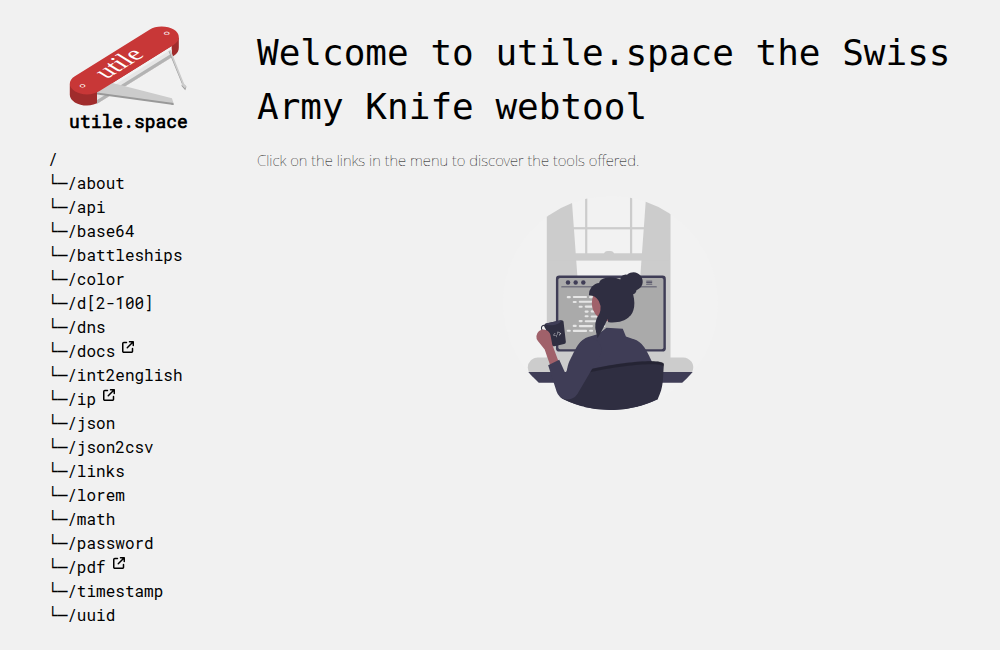
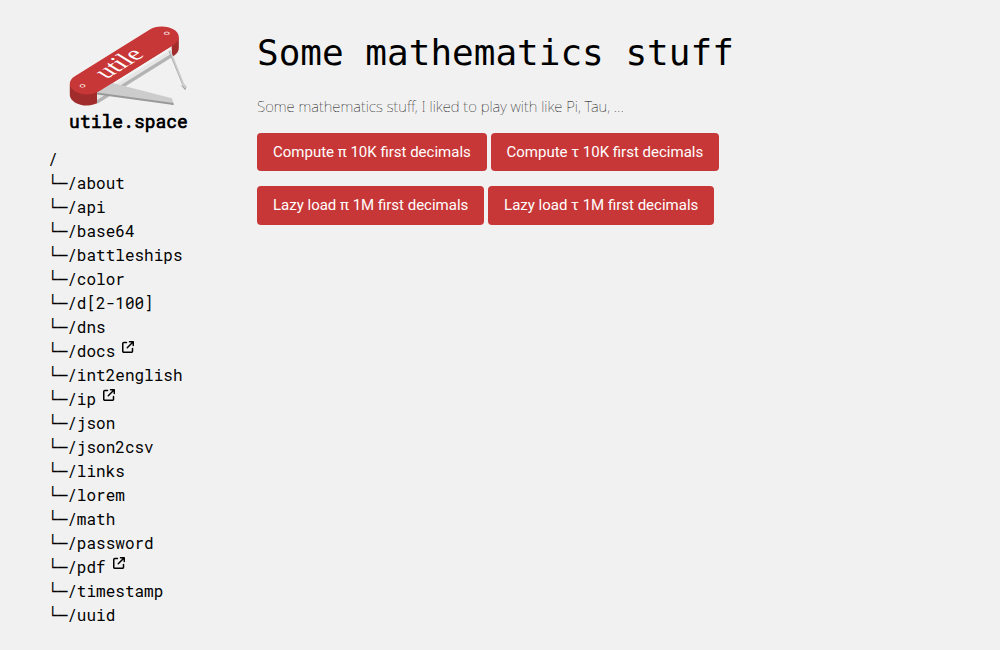
The menu has small tools like a password generator, timestamps, dice from d2 to d100, DNS lookup, Base64, JSON to CSV, UUIDs, and π or τ up to a million decimals.
It also hosts some of my experiments: Battleships, Beathoven and an instance of Spectrum. Getting your IP is a separate small service, at ip.alvesdi.as.
How it’s built
The back end is an API in Go, with Swagger documentation. Nginx sits in front of everything, the services run with Docker Compose, and GitHub Actions builds and deploys them.
I started the front end in bare Dart, because I wanted to try something other than JavaScript. I reached a dead-end with binding values between the UI and the view models, gave up on Dart, and the front end is now in SvelteKit.
Where it is now
utile.space is at version 4.5.110. In 2021 I promised a series of articles about it. By 2024 the site was at version 4.5.0 and I had written none, so I wrote about how I failed at documenting the project.
Some of the 2021 goals are done: the code is open source, GitHub Actions deploys it, and the API has Swagger documentation.